Training with multiple GPUs
Distributed training
A sample of the framework for running distributed training can be found here.
An overview of the distributed training process is provided using the figure below.
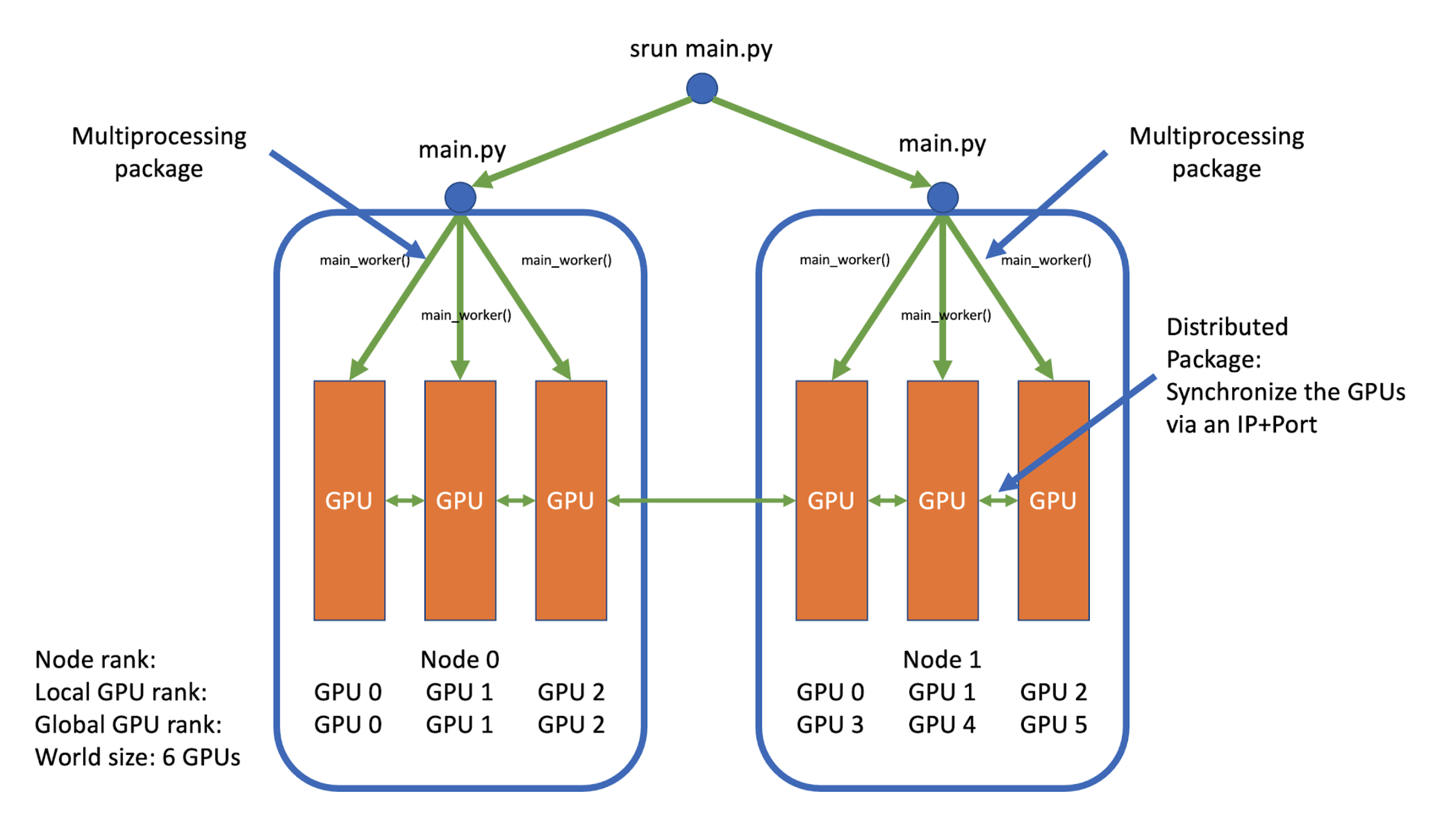
Let's assume that we are running experiments with a SLURM job system, using two
nodes and 3 GPUs per node. main.py is our job as illustrated in the figure
below. After we execute our job using srun main.py (see the script
here for details), main.py will be executed separately and
independently on each of the two nodes. This means that if variables are
modified or created in main.py on one node, they will not affect the
variables of main.py on the other node.
Then on each node, the multiprocessing package is used to execute the code in
main.py — let's call it main_worker() — in parallel on each of the three
GPUs available in the node. So now main_worker() is actually executed by six
GPUs in parallel, considering the two nodes we are using.
In each main_worker(), we create a dataset, a learning model, and an
optimizer, and train the model over multiple epochs. So we need something to
provide a tunnel for communication between the six GPUs and synchronise the
tasks running on them. The distributed package in PyTorch (DDP) is what
handles this. DDP is initialised at the start of main_worker() via
init_process_group(...), which requires the global GPU rank (see the figure
below), an IP address, and a free port (see the script here for
details of how to get them).
Principles when using DDP
- If the total number of GPUs is set to 10 while only six are available,
init_process_group(...)will keep waiting until the job is automatically killed after a long wait. - Each GPU has its own learning model. The learning models on the six GPUs
are identical. At each epoch,
distributed_samplerin DDP assigns each GPU a mini-batch of the same batch size, e.g. 128. So in total we are actually using a batch size of 128*6=768 for training. Each learning model then processes its mini-batch and computes gradients. DDP averages out all the gradients and sends them to each GPU, and each learning model is then updated using the same gradients. - Training errors differ across GPUs, because each is using a different mini-batch.
- Testing errors are identical across GPUs, so we only need to print the best test error and save the corresponding checkpoint on one GPU — e.g., the GPU with a global GPU rank of 0.
Each GPU is controlled by one process, also called a CPU, a worker, or a core.
Usually we request a bunch of workers when executing srun main.py, e.g., 42
workers per GPU. So if we use 12 workers per GPU for the dataloader and one
for controlling the GPU, 29 workers remain idle.
You can try out DDP yourself with the framework available here.
Further reading
How to run tasks with multiple GPUs and PyTorch: here, here and here
How to get the IP address of the node: here